The global order and economy appear to be going through seismic changes or, as Mark Carney (Canada’s PM) recently put it, a rupture. This moment of instability may offer an opportunity for global leaders to push for a transition towards a more sustainable, nature-positive economic model. Just last week, the high seas treaty came into force, proof that moments of rupture can catalyze the bold action nature needs.
The nature-positive economy can only be achieved if leaders have the right mindset and create the right cultures within their organizations, and if we start valuing nature at least in the same way we value the products and services we buy.
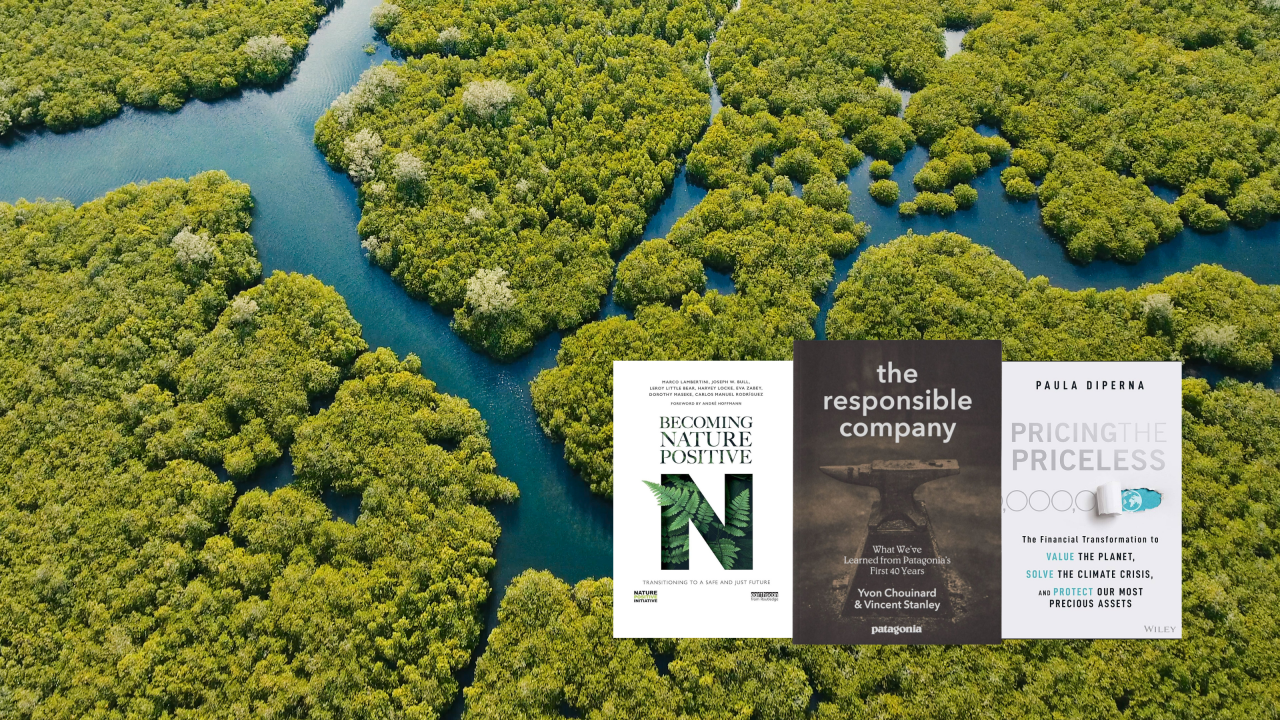
In this post, I share five shifts required for organizations to move from intention to action on their nature-positive journey. These ideas result from recent engagements, discussions, and several publications I highly recommend, including three books in particular:
Becoming Nature Positive, co-authored by Marco Lambertini, former Director General of WWF International, and six fellow leaders of the Nature Positive Initiative, provides a comprehensive roadmap for businesses transitioning to nature-positive operations.
The Responsible Company by Yvon Chouinard, Patagonia’s founder, and Vincent Stanley offers hard-won lessons on building a business that takes full responsibility for its environmental and social impacts.
Pricing the Priceless by Paula DiPerna, former President of CCX International and Special Advisor to CDP, explores the challenge of valuing ecosystem services through financial innovation.
Together, these works point to a simple truth: becoming nature-positive requires fundamental shifts in how organizations think, measure, design, and collaborate.
The five shifts organizations must make:
- Recognize Earth’s limits
- Measure nature’s value and regulate impacts
- Create a nature mindset and culture
- Design and innovate with nature
- Collaborate through value chains and geographies
Recognize Earth’s limits
Human civilization has progressed for most of its recent history believing that nature and its bounties are limitless. This assumption was already exposed over 2,000 years ago when Eratosthenes calculated the Earth’s circumference for the first time in Egypt, yet two thousand years later, our economic institutions appear to have ignored this revelation altogether.
The 1972 Limits to Growth report, commissioned by the Club of Rome and developed by MIT, predicted that if growth continued at then-current rates, ecological collapse could occur by the middle of the twenty-first century. Fifty years on, we have lost 73% of monitored wildlife populations, altered 70% of Earth’s land, and degraded 50% of our ecosystems.
The tragedy of the commons is now happening at the planetary level. Johan Rockström of the Stockholm Resilience Centre reminds us that we have surpassed seven of the nine planetary boundaries – the critical thresholds that enabled human civilization to flourish. Overshoot Day has moved from December 25 in 1971, the first year humanity consumed more than Earth could regenerate, to July 24 in 2025. Even today, extraction pressures continue to expand, including in places like Venezuela, one of the few countries where over 50% of land remains protected.
Thankfully, recent global agreements such as the Kunming-Montreal Global Biodiversity Framework signal that the world may be ready for change.
The first shift organizations and governments must make is to fully understand Earth’s limits and recognize nature as a source of invaluable ecosystem services, a critical infrastructure, and a core element of national security. Following E.O. Wilson’s vision in Half Earth, a just partnership with the natural world is essential for our survival. The question is how we continue to innovate, compete, and grow while attaining this balance.
Measure nature’s value and regulate impacts
There is a widely cited figure suggesting that 50% of our economy depends on nature. I would challenge this – 100% of our economy and our lives are fully dependent on it. Our health, wellbeing, and quality of life are inseparable from nature. The problem lies in how we have evolved to see ourselves and our economies as separate from it. They are not.
To change this, we must first make nature visible in our economic systems.
Many nations are developing natural capital accounts following the UN’s System of Environmental-Economic Accounting (SEEA), translating nature into metrics that can be tracked alongside GDP. In Pricing the Priceless, Paula DiPerna provides a comprehensive overview of progress in valuing biodiversity and ecosystem services.
Organizations must follow suit by measuring their dependencies on and impacts to nature, and integrating these into balance sheets and decision-making. Leading organizations are already adopting standards such as TNFD and CSRD alongside natural capital accounting methodologies. Through my work with Roland Berger in the UAE and Namibia, I have seen how quantifying ecosystem value – from mangrove coastal protection to kelp carbon sequestration – can fundamentally reshape how governments and businesses prioritize nature in strategic decisions.
Create a nature mindset and culture
You cannot manage what you don’t understand, and you cannot value what you don’t appreciate. This is why mindset and culture represent both the greatest barrier and the greatest opportunity for nature-positive transformation.
One of the biggest societal challenges globally is the lack of appreciation for the natural world. As Baba Dioum wisely said: “In the end we will conserve only what we love; we will love only what we understand; and we will understand only what we are taught.” Over 50% of us now live in cities, and too many children who become leaders are raised deprived of nature – often making decisions that further remove us from it and exacerbate the ecological crisis.
This lack of connection to nature is perhaps the biggest obstacle to progress. Education at the leadership level is the most powerful lever for change. New frameworks like the TNFD can help, but what’s even more important is hiring people who understand nature’s value and empowering them throughout the organization.
Governance is also essential – nature and sustainability should have dedicated functions reporting directly to the CEO. Over time, the combination of education and governance creates the mindset needed to transform how products and services are designed and delivered.
Design and innovate with nature
This shift presents perhaps the greatest opportunity for transformation and value creation in the nature-positive economy.
As Yvon Chouinard (Patagonia’s founder) and Vincent Stanley clearly articulate, 90% of a product’s environmental impacts are committed in the design phase. Design and engineering teams, including those in financial institutions, should work with nature not against it.
Organizations must treat nature as part of the value they create, not merely a risk to mitigate or a philanthropic concern. While technologies such as AI and GIS can help protect key biodiversity areas, the deeper challenge is rethinking products and services through a full lifecycle lens.
A simple test applies: if more of your product or service is sold, is nature better off? Are ecosystems and biodiversity thriving as a result?
Collaborate through value chains and geographies
Responsible organizations assess impacts across their entire value chain and lifecycle. The only way to make this happen is through collaboration with suppliers and partners along value chains.
Cross-border collaboration is equally unavoidable. Organizations with global footprints must apply the same standards wherever they operate, going beyond compliance to lead the transition to a nature-positive economy.
Nowhere is this more evident than in extractive value chains. Globalization has shifted many polluting and resource-intensive activities to countries with weaker regulations – including the sourcing of rare earth elements and critical metals for smartphones and electric vehicle batteries from places like the DRC, Myanmar, and Venezuela. Where local leadership falls short, multinational companies have an opportunity to step up – ultimately securing resilience and competitive advantage over the long term.
Looking ahead
The transition to a nature-positive economy is an imperative for organizational survival. Companies that fail to integrate nature into their strategy and operations will find themselves increasingly vulnerable to the destabilization of the very Earth systems their business models depend upon.
The Club of Rome’s 1972 warning is no longer theoretical – we are living the collapse they predicted. These five shifts offer the pathway out: not as isolated initiatives, but as interconnected levers for systemic change. Recognizing limits, measuring value, transforming cultures, redesigning with nature, and collaborating globally are the mechanisms that can redirect entire economic systems. The organizations bold enough to pull these levers together will create the regenerative, nature-positive, economy our planet desperately needs.


Leave a Reply