The Amazon is the largest and most biodiverse rainforest on Earth, a critical carbon sink and climate regulator. It is also under immense threat. Global Forest Watch reports that Brazil has driven around 40–50% of global primary forest loss in recent decades, followed by Indonesia and the DRC. In just four decades, the Amazon has lost nearly 90 million hectares – an area the size of Texas.
The stakes could not be higher. Scientists at COP30 warn we’ve nearly exhausted our carbon budget for staying below 1.5°C – the threshold beyond which climate catastrophe accelerates. Richer nations have already spent most of this budget, while global emissions keep rising. The math is brutal: without immediately halting deforestation and phasing out fossil fuels, we will breach 1.5°C sooner than expected. And when the Amazon goes, so does our last, best chance at climate stability.
Halting deforestation is essential not only for climate but to protect the Amazon’s extraordinary biodiversity and the Indigenous cultures that have long sustained it. The Amazon is home to Indigenous peoples whose knowledge, spirituality, and traditions have safeguarded the ecosystem for millennia. But as the global economy and modern life encroach, many communities are pulled away from ancestral lands and practices – a tension that becomes all the more urgent as COP30 takes place in Belém, Brazil.
Twelve years ago, through my ecotourism business, I led a Canadian student group deep into the Amazon, where we helped a village build a youth center – a space where young people could preserve their traditional arts and music and reconnect with their cultural heritage. That experience taught me something profound: responsible impact travel can support Indigenous communities while offering travelers invaluable lessons about collaboration and humanity’s bond with nature.
In this essay, I share that journey and reflect on what I learned about the irreplaceable role Indigenous communities play as forest guardians. I examine how the extractive economic system and global consumption – particularly our appetite for meat – drive both deforestation and cultural erosion. I also explore signs of hope: from COP30 to recent gatherings in Cali and Abu Dhabi, the world is finally recognizing that Indigenous stewardship isn’t just morally right – it’s essential to our survival.

On the ground: Leading a community impact expedition in the Amazon
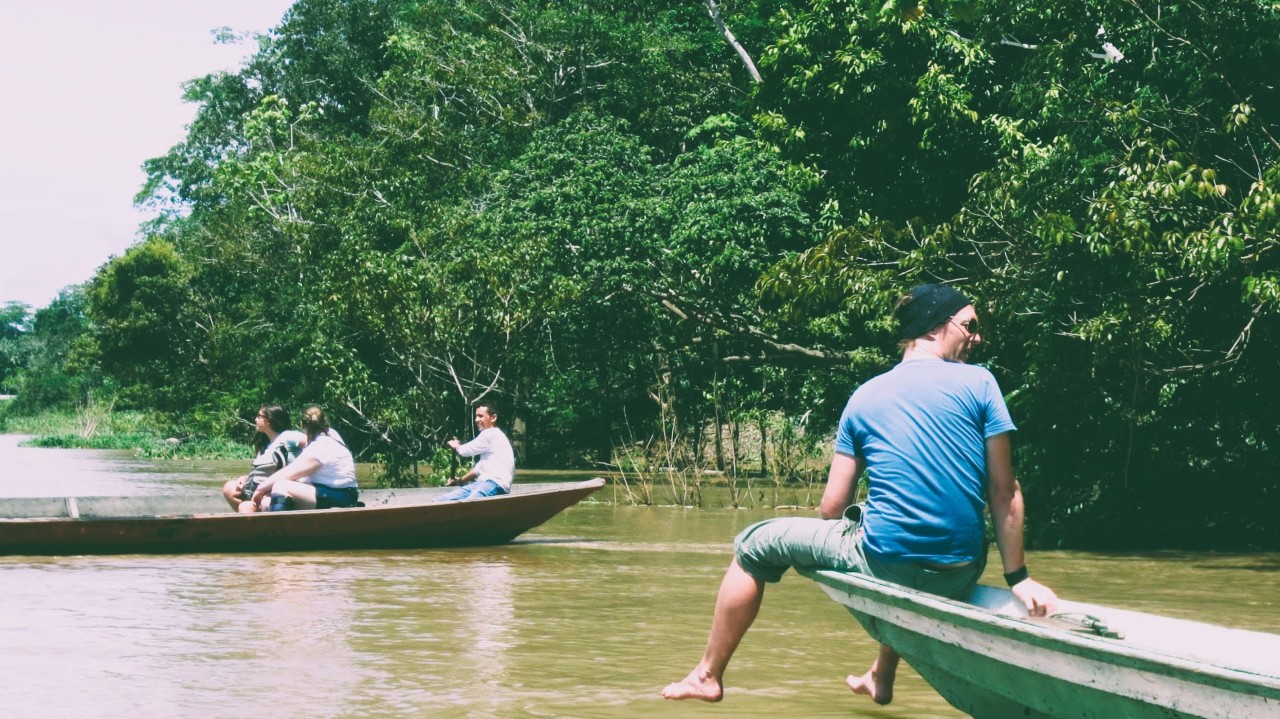
In February 2014, we flew into Manaus, the great gateway to the Amazon, and from there boarded a slow river boat heading deep into the rainforest. After hours of navigating the Amazon’s vast waterways, we finally reached the riverine community of Anamã. This small community sits in what might be called the Amazon’s ‘middle ground’ – accessible enough to welcome visitors, yet still deeply shaped by traditional river life. Deeper in the forest, many isolated indigenous groups remain in voluntary isolation across the Brazilian Amazon.
This journey was part of an impact expedition organized through my ecotourism company, which over the years led hundreds of educational and community-focused expeditions across five continents. The trip and on-the-ground work were led by our Brazil expedition leader, Leonardo, in close collaboration with François, the head teacher of the Canadian school, who already knew the community and helped build trust and continuity.
The project itself had begun six months earlier. Together with the people of Anamã and Ingénieurs Sans Frontières (an NGO), we co-developed a plan for a small community and youth center built on stilts – combining traditional materials and techniques with a modern twist to withstand the dramatic seasonal floods of the Amazon floodplain.
We spent most of our two weeks in the Amazon working side by side with the villagers to advance the construction of this center. The students stayed in homestays with local families, fully immersed in their daily life – learning local recipes, helping with small chores, sharing long evening conversations, and discovering the slow rhythm of a community shaped entirely by the Amazon. They also bonded naturally with the youth of Anamã: playing football, joining in local games, and sharing laughter that transcended languages.
Our days on the river also revealed the Amazon in all its raw immediacy. We went piranha fishing, tasted fresh cacao fruit straight from the tree, learned forest skills from residents who read the landscape like a language, and spent one night sleeping on hammocks aboard a traditional wooden river boat, wrapped in the hum of the rainforest. We even swam in the warm, dark waters of the Amazon – a thrilling moment none of us forgot.
To close the trip, we flew to Rio de Janeiro, and our visit coincided with the height of the Rio Carnival, one of the most extraordinary cultural celebrations on Earth. For two days, we immersed ourselves in the electrifying energy of the city: the thundering samba rhythms echoing through the streets, and the sense of collective joy that swept through Copacabana, Ipanema, and beyond. We also spent time in Rio’s favelas, joining a samba percussion class and supporting a community-based tourism initiative that seeks to improve local livelihoods and the urban environment. It was such a powerful contrast to the Amazon!
Experiences like these reveal both the promise and the paradox of responsible tourism in remote areas. Done right, impact travel can support the preservation of Indigenous values and cultures while generating economic benefits that reduce pressure on forests. For travelers – especially young people – these journeys are transformative. Students return home with lessons about collaboration, humility, and humanity’s interdependence with nature that reshape their studies and their lives.
But we must also acknowledge an uncomfortable truth: even well-intentioned visits inevitably bring change. The very presence of outsiders – with our technologies, our economic power, our different values – begins to transform the cultures we seek to support. This is why such expeditions demand the highest degree of cultural sensitivity, genuine partnership, and above all, respect for communities’ right to self-determination. And for some communities, like the Amazon’s uncontacted tribes, the most respectful choice is to leave them entirely undisturbed – to honor their desire for isolation as an act of preservation in itself.

The Amazon’s over-exploitation and the disappearance of indigenous cultures
Deforestation: a problem as old as civilization
The Amazon, along with Indonesia’s tropical forests and the Congo Basin, remain the largest tropical forests on the planet and the richest reservoirs of biodiversity – and simultaneously the most exploited. According to Global Forest Watch, Brazil, Indonesia, and the DRC together accounted for most global primary tropical forest loss in the last decades; Brazil alone suffered roughly 40–50% of that loss. Over the past four decades, the Amazon has lost roughly 90 million hectares of its forest cover, or nearly the size of Texas or Colombia.
But humanity’s assault on forests is hardly new. Deforestation has shadowed human civilization since its very dawn. The United States and Europe lost most of their primary forests over the last few centuries due to over-extraction. Long before, the great civilizations of ancient Greece, China, the Fertile Crescent, and Egypt severely degraded their ecosystems through deforestation, intensive agriculture, and unsustainable logging.
This over-exploitation of nature contributed both to the rise and the eventual collapse of these societies. As Jared Diamond notes in Collapse, “Deforestation was the major factor in all the collapses of past societies described in this book.” Greece’s forests tell a similar story: as early as 400 BC, Plato observed that “what now remains compared with what then existed is like the skeleton of a sick man, all the fat and soft earth having wasted away.” Today, only about a quarter of Greece remains forested.
In the mid-19th century, George Perkins Marsh, serving as U.S. Minister to Turkey, traveled extensively through Egypt and the broader Mediterranean region. What he witnessed there – the barren hillsides, the degraded soils, the desertification of once-fertile lands – became the foundation for his groundbreaking 1864 book Man and Nature. Marsh documented how ancient Mediterranean civilizations, including those of Egypt and the Fertile Crescent, had brought about their own collapse through environmental abuse. Referring to these once-lush lands, he wrote that “the operation of causes set in action by man has brought the face of the earth to a desolation almost as complete as that of the moon.” Despite Marsh’s warnings, the United States and Europe still lost most of their primary forests, showing that scientific knowledge and modern governance alone have not been enough to safeguard these ecosystems. By contrast, Indigenous knowledge – developed and refined over millennia – offers essential lessons for protecting the Amazon and other remaining primary forests today.
Indigenous knowledge: more than a relic
Indigenous peoples have lived in and managed forests for thousands of years, developing ecological practices that align with natural cycles. Their wisdom – on when to harvest, when to let the land rest, how to maintain soil fertility, how to balance dietary needs with ecosystem stability, and even how to regulate family size in harmony with the ecosystem – offers crucial lessons for today’s environmental challenges.
Research indicates that about 80% of the planet’s biodiversity occurs on lands inhabited or managed by Indigenous peoples, highlighting their role as nature’s guardians. In the Amazon, Indigenous communities continue to maintain these ecosystems, including 95% of the world’s 196 uncontacted tribes (124 in Brazil alone, according to Survival International). Yet the pressures of modernization, urbanization, and cultural assimilation are reshaping these communities. More than half of Amazonian Indigenous peoples now live in towns or cities such as Manaus or Anamã; while many retain aspects of their traditions, most now speak Portuguese and practice Christianity.
If current trends of deforestation and displacement continue, the Amazon could lose another 25% of its current forest cover by 2050, bringing the total area at risk of ecological tipping points close to 50%, according to recent ecological models. This scenario would coincide with significant losses of Indigenous cultures, knowledge, and stewardship that have protected the forest for thousands of years.
The loss of indigenous cultures: Climate and biodiversity risks
The loss of Indigenous cultures is both a moral issue and a systemic risk for biodiversity and climate stability. Over centuries, conquest, colonization, and development eroded many traditional ways of life, and today, Indigenous communities face pressures from extractive industries – meat, timber, mining – as well as the allure of modernity: education, technology, consumer goods and urbanization. These forces can pull young people away from forest-based traditions, undermining both culture and the ecosystems these communities have protected for generations.
During my two weeks in the Amazon, I witnessed this paradox firsthand. Communities we met were deeply rooted in their ancestral lands, yet many of their children aspired to live beyond the forest, drawn by smartphones, urban ideas, and economic opportunity. These shifts risk breaking the delicate systems that have allowed ecosystems to regenerate for millennia.
The central challenge is clear: supporting Indigenous cultures so they can thrive in a changing world is not only a cultural and moral priority – it is essential for maintaining the ecosystems upon which life and climate stability depend.

Re-igniting indigenous knowledge and cultures to reverse the crisis
As COP30 draws to a close in Belém, Brazil, the world is watching whether the country can deliver on its promise to end deforestation by 2030 – a commitment essential for keeping the 1.5 °C target within reach. Brazil has taken meaningful steps to achieve this goal by increasingly recognizing the central role of Indigenous peoples in protecting these forests. For example, the Tropical Forests Forever Facility (TFFF), launched at COP28, dedicates at least 20% of its resources to Indigenous communities. Initiatives such as the COP30 “Circle of Peoples” and the International Indigenous Commission integrate Indigenous voices into climate negotiations, while the COP Village and regional mobilization meetings help prepare communities to participate effectively.
Other international platforms are also advancing Indigenous rights and recognition. At UNCBD COP16 in Cali, Colombia, a new body for Indigenous peoples was formally established, giving them a stronger voice in global biodiversity governance. At the IUCN World Conservation Congress in Abu Dhabi, the IUCN’s first-ever Indigenous Peoples Summit marked a historic milestone for the world’s largest conservation organization.
Legal precedents are also setting a powerful example. Ecuador became the first country in the world to recognize the rights of nature in its constitution, a framework that paved the way for landmark rulings such as the Amazonia Waorani tribe winning protection against corporate encroachment on their lands. These landmark decisions have inspired other nations: in Brazil, the Supreme Court recently rejected the “time-limit” (marco temporal) thesis, reaffirming constitutional protection for Indigenous territories – a victory for forest-dependent communities across the country.
Building on global and national commitments and initiatives, the private sector also has a critical role to play. By recognizing the intrinsic value of Indigenous knowledge and the importance of protecting primary forests and their ecosystems, businesses and NGOs can support communities through ecotourism, regenerative agriculture, biodiversity-based payments, and other activities that restore rather than exploit.
At the same time, supporting Indigenous land rights and livelihoods comes with complexity. Modern influences and material temptations – including those that can arise even from well-intentioned impact travel projects like the one I led in the Amazon – can pull communities away from their traditional practices, weakening the stewardship that has preserved these forests for generations. Some groups, such as uncontacted tribes, may be better off remaining undisturbed and shielded from modern culture.
The question remains: are we truly listening to those who have protected these forests for millennia? Pledges, funds, legal victories, and responsible ecotourism experiences only matter if they translate into real rights, respect, and the strengthening of Indigenous culture in the forests and ecosystems where it counts most.
Re‑igniting Indigenous knowledge and cultures is not just about preserving tradition. It is a vital pathway to reversing ecological and climate breakdown, a test of justice and resilience, and a source of hope – for the Amazon, its peoples, and for all of us.

Leave a Reply