My recent family trip to South Africa made me rethink my perception of cities, particularly as we explored Cape Town and its surroundings.
Here was a city that had woven nature and biodiversity into urban life – shaping a place that feels more resilient, more livable, and healthier for children growing up within it.
While we could choose to live outside cities in more natural settings, we remain drawn to the energy, diversity, and opportunities that urban life offers. That’s why I moved my family from Montreal to Dubai a few years ago – to be at the center of action in the Middle East, surrounded by people, ideas, and experiences that continually shape and challenge us, while giving us the chance to make a meaningful impact and influence the world around us.
Integrating nature into cities is not a new idea. From the gardens of Babylon to the great public parks of the nineteenth century, green space was once inseparable from urban life. Somewhere along the way, under the pressure of population growth, real estate, and short-term thinking, we pushed nature to the margins of city design and governance.
By 2050, roughly 70% of humanity will live in cities. We urgently need to transform these urban areas into more just, inclusive, and healthy environments – where children can play outdoors, reconnect with the natural world, and where biodiversity can thrive alongside us – a goal that some cities, like Cape Town, are already showing is possible.
Our family journey through Cape Town
I don’t usually linger long in cities when travelling with family, but Cape Town earned a full week – and it gave back more than we expected.
We arrived at the V&A Waterfront, the beautifully restored port area built around an old Victorian harbor – one of the most walkable urban waterfronts I have encountered, with cafes and terraces spilling out towards the ocean. Our hotel, a converted nineteenth-century prison, set an appropriately layered tone for what was to come.
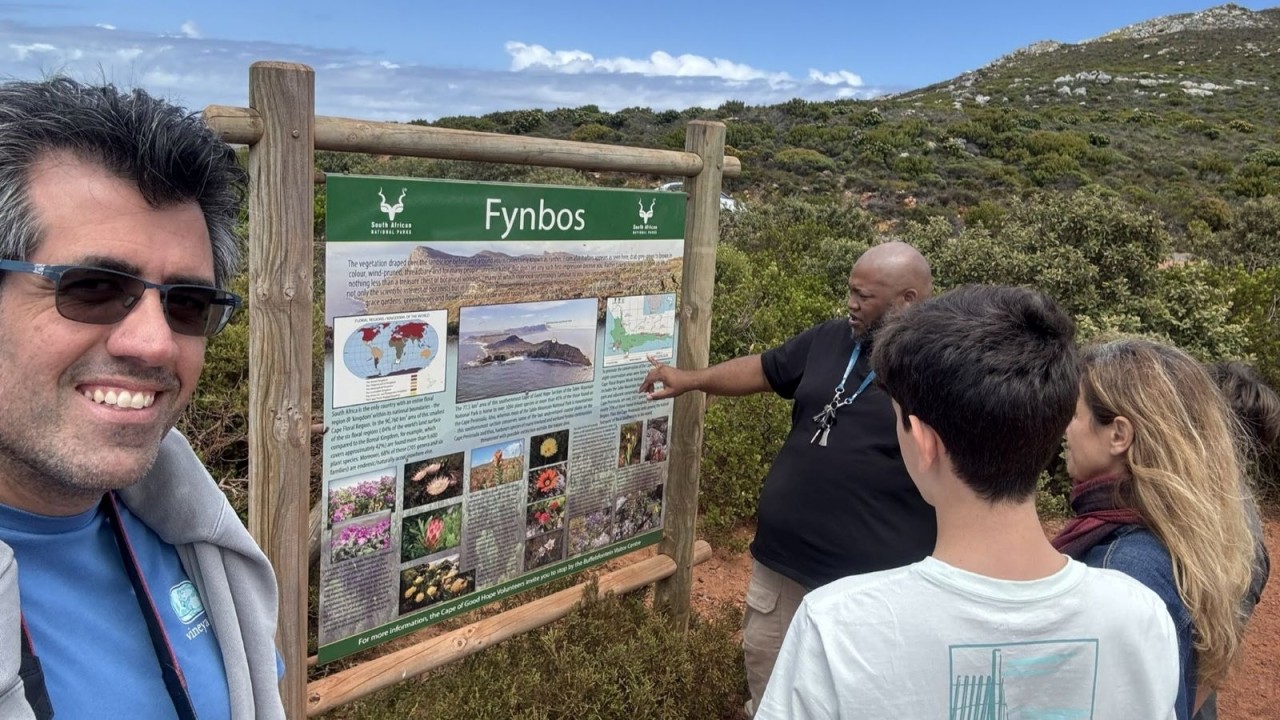
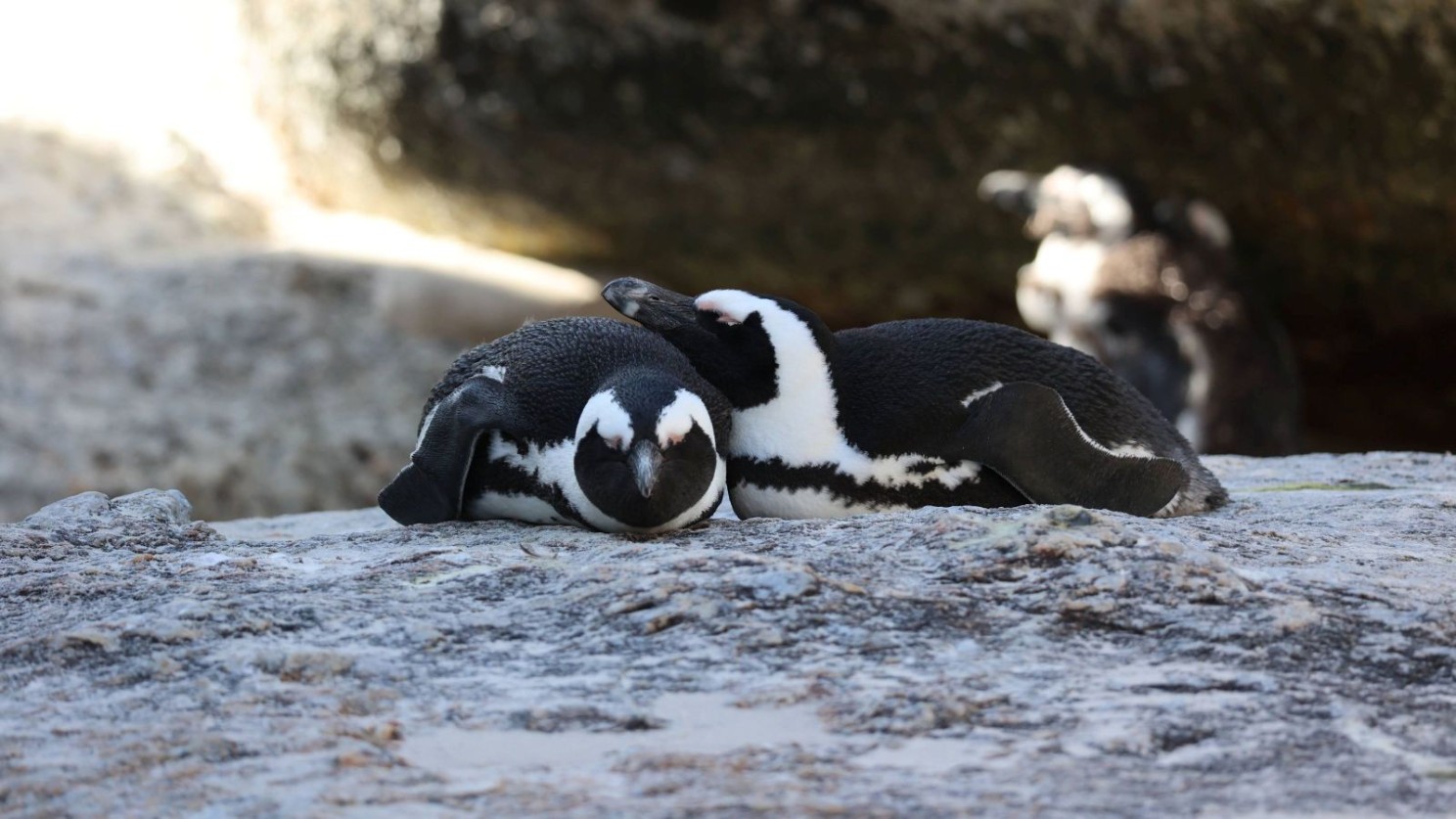
The following day we drove south with our guide Clement along one of the world’s great coastal roads, stopping through the Table Mountain National Park – which stretches from the heart of the city all the way to Cape of Good Hope, the most southwestern point of the African continent. We encountered elands and bonteboks grazing in fynbos (the low, hardy shrubland unique to this region), wild ostriches, Egyptian geese, and hundreds of species of the Cape Floristic Region’s extraordinary plants, most famously the Protea. At Boulders Beach, we sat quietly among one of the last remaining African penguin colonies – a fragile, moving encounter with a species under serious threat. At the Cape Point lighthouse, the views across both oceans felt like standing at the edge of the world.
The days that followed, we hiked Table Mountain to the upper plateau, with its sweeping views over the city, the Cape Peninsula and both oceans, and bathed at Camps Bay in bracingly cold Atlantic water. But two experiences stood apart: the District Six Museum – housed in a former church, it gave our children their first visceral encounter with the reality of Apartheid – and Robben Island, where our guide had spent years imprisoned alongside Mandela himself, who served 18 of his 27 years in prison on that island. He walked us through those corridors with an intensity that filled every room.
We ended the week in Franschhoek, a small valley town tucked between the Wemmershoek and Groot Drakenstein mountains, where French Huguenot refugees built a winemaking tradition that still thrives today. We rode the Franschhoek Wine Tram between estates, stayed in a cabin overlooking a creek and vineyards, and ate extraordinarily well.
On the drive back to Cape Town we stopped at the Iziko South African Museum – sitting within the historic Company’s Garden. Among its extraordinary collection, the one that stopped us in our tracks were the therapsids: 250 million-year-old mammal-like reptiles from the Karoo, the ancient creatures that bridge the gap between reptiles and the first mammals, and whose fossils survived the greatest extinction event our planet has ever known. Just outside, the garden, originally laid out in 1652 by the Dutch East India Company – history’s first multinational corporation and the organization that created the world’s first stock exchange – is a green oasis at the heart of the city, quietly connecting nature and urban life.
How Cape Town thrives with nature
Few cities are framed by nature quite so dramatically. Table Mountain – one of the oldest mountains on Earth – rises directly behind the city center. The Cape Peninsula stretches south into the ocean, flanked on one side by the cold Atlantic and on the other by the warmer waters of False Bay. And beneath all of it lies one of the most extraordinary ecosystems on the planet.
Walking the fynbos with our guide Clement, we saw how Cape Town sits at the heart of the Cape Floristic Region – a UNESCO World Natural Heritage Site and the smallest of Earth’s six floral kingdoms, yet the richest per unit of area. Over 9,000 vascular plants grow here, nearly 70% found nowhere else on Earth. Beyond Table Mountain National Park, the city protects its ecosystems through more than 20 urban reserves, maintaining ecological corridors that thread nature into the fabric of the city.
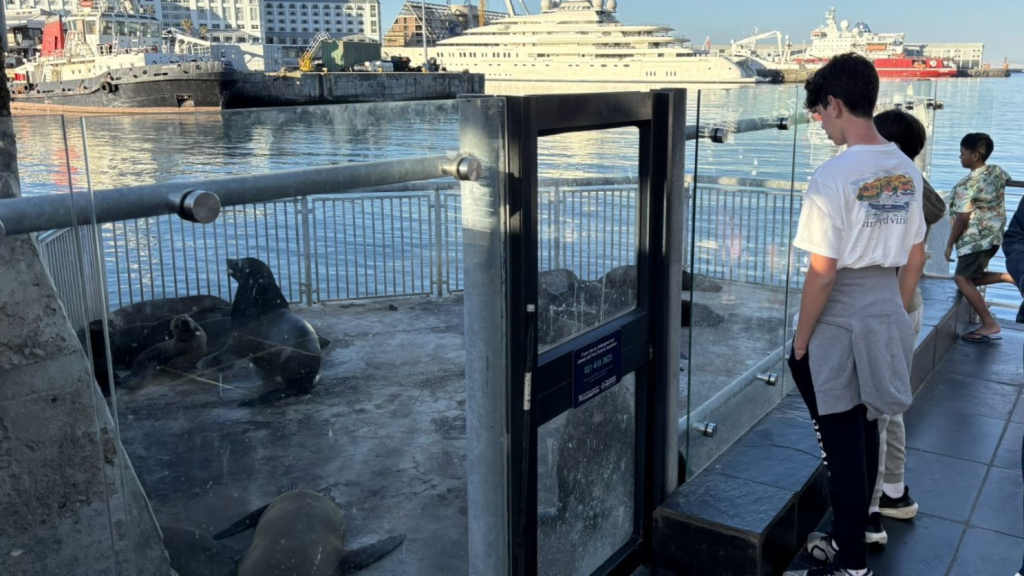
Capetonians engage with wildlife in remarkable ways. In the City Nature Challenge – a global citizen science competition – Cape Town has consistently ranked among the top cities since 2019, winning both the most species and most observations categories and demonstrating how residents value urban biodiversity. We saw this instinct firsthand while waiting for our boat to Robben Island: my boys were transfixed by a platform covered in Cape fur seals, designed to give the animals their own space while a permanent disentanglement program monitors the harbor. At Boulders Beach, we walked among African penguins – now Critically Endangered – and noticed the artificial nest boxes that help more chicks survive to leave the nest, increasing fledgling survival by 16.5%
Cape Town ranks first in Africa for quality of life and livability, and 9th globally for resident-rated access to nature and green spaces – surveys consistently citing its natural beauty and coastline as the primary draw. It has been named Africa’s Leading City Destination four consecutive years. It is a city shaped by its nature – and one that, to a remarkable degree, has chosen to shape itself around protecting it.
That choice, however, is far from universal.
The cost of rapid urban growth
Working recently on an urban biodiversity strategy for a Middle Eastern capital, I witnessed first-hand the remarkable progress cities in the region are making – new restoration programs, expanding green areas, stronger governance, and growing political commitment to biodiversity. Yet rapid urban growth remains a formidable challenge, generating pollution, and steadily eroding ecosystems in ways that can quietly offset even the most ambitious conservation investments. Visiting nature reserves, parks, and waterways across the region, I encountered this contradiction directly – illegally dumped waste, for example, a recurring sight in some of the most beautiful landscapes, undermining restoration work that had taken years and significant resources to achieve.
Globally, perhaps no choice shapes our lifespan and healthspan more profoundly – or more invisibly – than the decision to live in a large city. Blue zones – those rare places on Earth where people regularly live past 100 – are villages, islands, and rural communities: Okinawa, Sardinia, the Nicoya Peninsula, Ikaria. Not megacities. The two leading global risk factors for premature death are high blood pressure and air pollution – both of which cities systematically worsen. WHO estimates that 99% of the world’s population breathes air that exceeds safe limits, and air pollution alone now accounts for 8.1 million premature deaths per year, surpassing tobacco.
Today, more than half the world lives in cities, and in more industrialized nations that figure exceeds 80%. But while cities are a relatively recent chapter in our evolutionary history, without them we would not have built civilization. Memphis, Babylon, Athens, Rome, and more recently Paris, Washington or Beijing: all were founded on fertile, healthy ecosystems – primarily freshwater systems and rivers – the very ecosystems suffering the most damage today. Over the past fifty years, freshwater wildlife populations have declined by 85%, and rivers are today the conduit for 80% of ocean plastics.
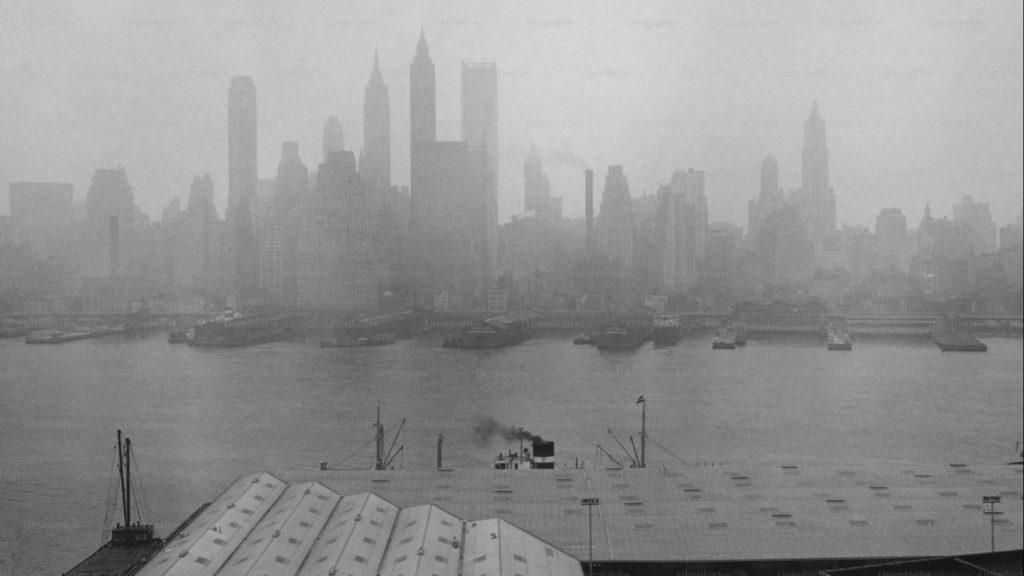
Coastal cities have also flourished thanks to – and at the expense of – their surrounding ecosystems. In The Big Oyster, Mark Kurlansky recounts how the waters surrounding New York once contained half the world’s oysters – a living filtration system and food source for rich and poor alike, spread across 350 square miles of estuary beds. By 1930 the last of them were permanently closed, killed by industrial pollution.
Similar stories are found around the planet. Dubai for example was built on pearls. But when the trade collapsed in a single decade in the 1930s – due to Japanese cultured pearls and the Great Depression arriving simultaneously – the pearl beds fell silent and the relationship between the city and its sea was permanently redrawn.
Cities are also the primary drivers of global energy consumption and the extractive economy. They account for roughly 75% of global energy demand – a share accelerating rapidly with the rise of AI and data centers. The scale is almost impossible to conceptualize since the turn of the century, humans, as a single species, consume more energy than all other animals on Earth combined.
Urban areas also consume the vast majority of the world’s cement and concrete – materials whose production requires enormous quantities of sand, primarily extracted from riverbeds, devastating the very freshwater ecosystems on which the earliest cities were built.
This is a topic close to my own family story. My great-grandfather established Egypt’s first cement factory in 1911, in partnership with an Italian industrialist – one small thread in a pattern that has since become staggering. Global material extraction has increased more than tenfold since 1900, driven primarily by minerals such as sand, gravel, and limestone – which now make up roughly 45% of today’s 107 billion tons of annual global extraction.
We live in an era that likes to think of itself as weightless – where value is created by algorithms, not quarries. The ground tells a different story. As Ed Conway writes in Material World: no matter how advanced we become, our civilization remains rooted in the materials we pull from the Earth. According to the IPCC, three-quarters of the infrastructure that will exist in 2050 has yet to be built – the largest wave of construction in human history, concentrated overwhelmingly in the Global South.
This shift from a biomass-based living world to a built, mineral one is fundamentally altering how we relate to nature. It has given rise to one of the most dangerous developments in our societies – what experts call environmental generational amnesia, or the shifting baseline syndrome. Each new generation grows up knowing only the world they inherit – cities of concrete and noise, rivers without fish, skies without birds – and accepts it as normal. The diminished, engineered world becomes the baseline – and what was lost is simply never missed.
Too many cities built their wealth by consuming nature. A few – Cape Town among them – are learning to restore it.
Urban nature and biodiversity in action
Cities with the highest livability and quality of life scores consistently share a respect for nature. Cape Town is a striking example, and a growing number of cities around the world are following a similar path.
Montreal, the city where I have lived longest, exemplifies this. Montrealers hold Mount Royal at the heart of their city as almost sacred: by law, no building may surpass the mountain’s summit at 233 meters. From its unpaved trails, the breeze carries the scent of pine and maple, squirrels cross the leafy floor and songbirds flit between the trees – nature embedded in urban life, not appended to it. It is perhaps unsurprising from a city that hosts the UN Convention on Biological Diversity (CBD), whose province of Quebec became the first subnational government in the world to contribute financially to the Global Biodiversity Framework Fund, at CBD COP16 in Colombia in 2024.
Other cities have also raised the bar. London launched the world’s first City Biodiversity Action Plan in 1996. Paris renewed its Biodiversity Strategy in 2024, creating new urban forests across the city and, following a citywide ban on pesticides in public spaces, now hosts 118 documented species of wild bees. I remember walking those streets with my wife and young boys years ago, struck by how naturally the city held it all together – the centuries of layered architectural heritage, the Seine, the tree-lined boulevards, the parks – each element protecting and enhancing the others.
Berlin’s Biotope Area Factor, in place since 1994, legally requires new buildings to include ecologically effective green space, inspiring similar standards across Europe. Singapore, along with Nagoya, Montreal, and Curitiba, co-developed the Singapore Index on Cities’ Biodiversity, the first international framework recognizing cities as key actors in global biodiversity governance.
Global standards are reinforcing these local ambitions. The WHO’s 3-30-300 rule – every resident should see at least 3 trees from home, live in a neighborhood with 30% tree canopy cover, and be within 300 meters of green space – gives planners a simple, powerful benchmark for urban nature equity. The IUCN’s Urban Nature Indexes provide cities everywhere with a science-based framework to measure and improve their ecological performance.
In the Middle East, Abu Dhabi and Dubai hold the top regional livability positions, and their rising rankings track with investments in nature. During the IUCN World Conservation Congress in Abu Dhabi last October – which I contributed to as IUCN Ambassador – Abu Dhabi announced a binding Biodiversity Policy Decree alongside an expansion of protected areas to cover 20% of emirate land. Dubai also shared many of its nature and biodiversity initiatives at the Congress, including the Dubai Reef – one of the world’s most ambitious marine restoration programs – for which I moderated a panel with experts in reef restoration and marine biology.
In Dubai, I was also recently invited to join the Urban Biodiversity Coalition – launched by Terra, Expo City Dubai, in 2025, representing Roland Berger – which brings together over 40 organizations to embed biodiversity into the fabric of city life. One of its initiatives is Dubai’s participation in the City Nature Challenge, the global citizen science competition that in 2025 mobilized over 100,000 people across 660+ cities in 62 countries – among them Cape Town, Singapore, and Tokyo. What connects all these cities is a simple truth: when residents notice wild things in their midst, they begin to protect them.
Just as in Cape Town, these initiatives show that when cities intentionally embed nature into urban life, both people and biodiversity benefit.
Closing the nature loop
As more people live in cities, we have a moral duty to rethink how we plan, design, and inhabit them. We owe it to our families and communities – especially our children – to create healthy, green spaces where they can spend time and connect with nature.
Cities face a polycrisis – climate risks, health challenges, food insecurity, and economic fragility. Integrating nature into urban spaces helps address these challenges directly: green infrastructure manages floodwaters, urban forests cool streets and reduce heat stress, biodiverse ecosystems support pollination, food systems, and mental wellbeing, while restored habitats allow wildlife to return, strengthening ecological resilience alongside human communities.
Witnessing even small signs of wildlife returning reminds us that cities – and the children growing up in them – can reconnect with nature if we make space for it.
I think of my boys in Cape Town, stumbling upon seals at the harbor, penguins nesting between the rocks on the beach, birds threading through the fynbos on a hillside trail. They understood, instinctively, what was worth protecting. That natural curiosity – present in every child before the world crowds it out – is something we often forget. Cape Town reminded us that a city can be alive with nature, and that children can see and care for it without being told. The question is whether we will notice, and whether we will make room for it in the cities we live in.

Leave a Reply