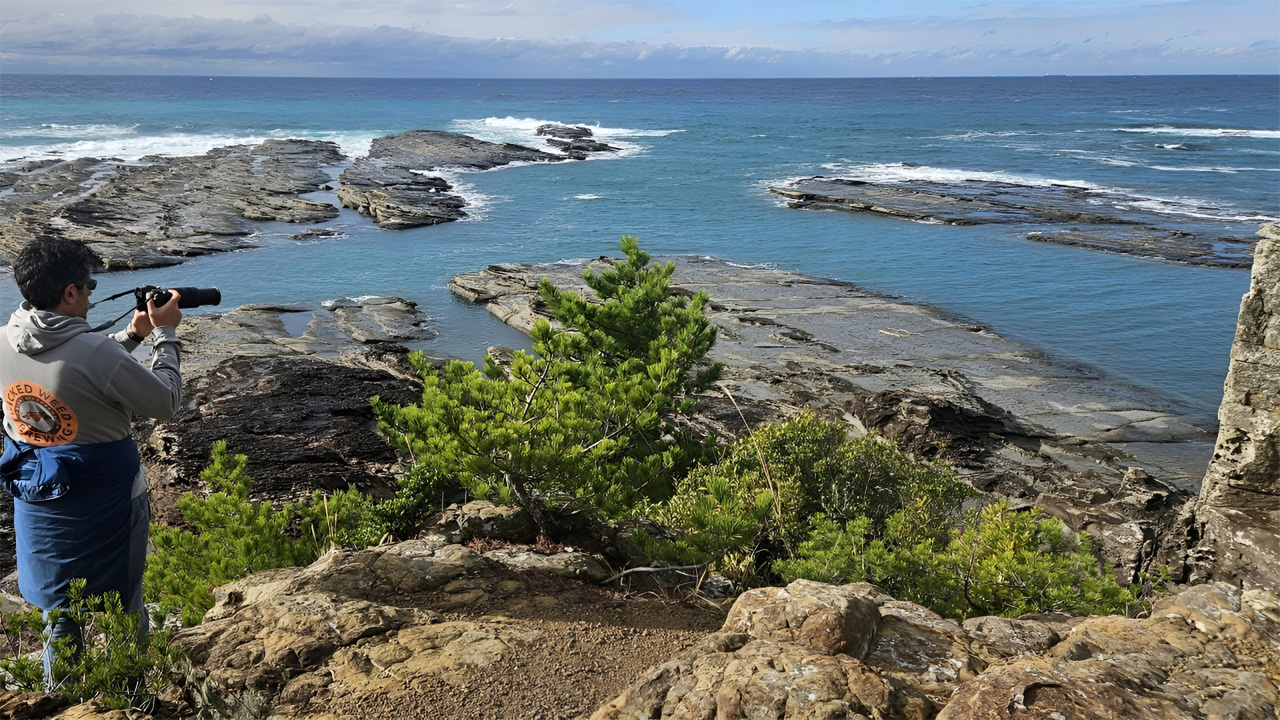
As the old parable goes, we work and build and grow so that one day we can afford to stop and go fishing. The problem is that we never stop. We keep growing in numbers, in consumption, in complexity – and the global economy now requires a relentless expansion of products, services, and technologies just to sustain itself. At nearly 9 billion people, having inhabited almost every corner of the Earth, we have reached a point where the cumulative value of our innovations appears to be offset by the value we continue to extract from the natural world – the very world that made our flourishing possible.
Earth Overshoot Day – the date by which humanity has consumed more from nature than the planet can regenerate in a full year – fell on July 24 in 2025. The first time we overshot was in 1970. In half a century, we have gone from living within our means to consuming the equivalent of 1.8 Earths per year.
The engine driving that trajectory is the way we innovate. More than a decade ago, I completed my PhD in strategy and innovation as part of what was then the largest management research project in Canadian history. I traveled to China, Taiwan, India, Switzerland, France, and California studying how nations and organizations compete through innovation – how they create value, capture it, and govern the partnerships that bring new technologies to market.
But what the field of innovation management had almost nothing to say about, back then, was nature – and the profound ways it underpins everything we build. The frameworks we used to map the logic of innovation were entirely disconnected from ecological systems. Looking back, that absence was a fundamental limitation of the social sciences – and of the economic system they were built to describe.
The core challenge now is to redesign these games – to innovate in ways that account for the full lifecycle of products and services and their relationship with the living world. That is what it means for innovation to be a positive-sum game with nature.
Innovating with nature – the RISE framework
Schumpeter, widely regarded as the father of innovation studies, described innovation as “creative destruction.” What he could not have anticipated was the ecological toll of that destruction. By solving one problem, we have systematically generated others, and too many of these unintended costs have been borne by the natural world. As Yvon Chouinard of Patagonia observed, 90% of a product’s environmental footprint is determined at the design stage. This is where the game must change.
The RISE framework offers a practical lens for innovating with nature rather than against it.
R – Reduce resource extraction. The starting point is design itself: products must be conceived from the outset to consume fewer natural resources, accounting not just for financial costs but for the full ecological cost of extraction – the damage to ecosystems and ecosystem services that conventional pricing ignores. Designing for durability follows naturally from this logic – every year added to a product’s lifespan is raw material not extracted, energy not consumed, waste not generated. This is why France became the first country to criminalize planned obsolescence, and why Canada followed. Biomimicry and biophilic design extend this thinking further, drawing on nature’s 3.8 billion years of R&D to develop materials and systems that are inherently more efficient and regenerative.
I – Integrate circularity. Linear systems that extract, produce, and discard must give way to designs that eliminate waste from the outset – closing material loops across entire product lifecycles. Companies that adopt this approach align with tightening regulations, including Extended Producer Responsibility (EPR) schemes, which hold manufacturers accountable for the full end-of-life impact of their products.
S – Systemize lifecycle thinking. No product exists in isolation. A full lifecycle approach accounts for all direct and indirect ecological costs across supply chains, demanding genuine collaboration with clients, suppliers, and the ecosystems they depend on.
E – Enrich ecosystems. The net-positive step: innovation that actively repairs what has been damaged. Companies using invasive seaweed or ocean plastic as raw materials exemplify this logic – turning ecological liabilities into design assets.
Businesses adopting this framework will gain a competitive advantage on multiple fronts, attracting talent, appealing to increasingly conscious consumers, and staying ahead of tightening regulations, including TNFD nature disclosure requirements.
The knowledge gap
The barrier to implementing this framework is primarily educational. Before my PhD, I trained as an industrial engineer. In four years of study, I was never once taught to account for nature in design or business decisions. The scientific revolution of the 17th century introduced a mechanistic worldview that reduced nature to passive matter, and the institutional model that spread globally from post-revolutionary France entrenched what sociologists call knowledge fragmentation – the division of human understanding into sealed disciplinary silos. Weber called it the “disenchantment of the world.” The engineer and the ecologist rarely share a classroom, let alone a design table.
AI as a bridge
AI offers genuine hope as a bridge across this knowledge gap. It can accelerate convergence in three interconnected ways.
First, knowledge integration: AI can help organizations collect and analyze the vast amounts of nature and biodiversity data required to identify nature risks and nature opportunities across their operations and supply chains. This dramatically accelerates the adoption of frameworks like the TNFD and tools like ENCORE and IBAT – developed in partnership with IUCN – by making complex biodiversity assessments faster, cheaper, and more actionable. AI also helps translate these dependencies and opportunities into financial terms – speaking the language of the boardroom and making the case for nature on the balance sheet. Ultimately, AI can help embed nature into engineering, design, strategy, and decision-making at every level of an organization.
Second, direct conservation: AI-powered monitoring tools – combining computer vision, satellite imagery, and acoustic sensors – are making ecosystem monitoring faster, cheaper, and more accurate than ever. For example, Google’s SpeciesNet can identify nearly 2,500 species from camera trap images, allowing research teams to process millions of photographs in days rather than years.
Third, AI offers a path to decoupling economic growth from demographic growth. If we had to pin down the current ecological crisis to one root cause, it would be the human population explosion of the past century – and the economic models that have made relentless demographic growth a prerequisite for prosperity. More people has meant more consumption, more extraction, and more pressure on ecosystems. AI is beginning to change this equation. Japan’s Society 5.0 – a human-centered vision that harnesses AI and robotics to sustain economic productivity despite a shrinking and ageing population – points toward a future where vitality no longer depends on more people consuming more resources. It is perhaps the most profound contribution AI can make: helping us grow wiser and wealthier without needing to grow larger.
Redesigning the rules of the game
The good news is that the field is catching up – even if the economy has not yet followed. Sustainable innovation is now a recognized discipline in its own right, with leading institutions from MIT Sloan to Cambridge’s Institute for Sustainability Leadership building programs around the nature-positive economy. The science is unambiguous: there is no economy without nature. Every product, every service, every technology ultimately rests on ecosystem function – not half the world’s GDP as some estimates conservatively suggest, but all of it.
The RISE framework, the growing field of sustainable innovation, and the emergence of AI as an ecological bridge all point toward the same possibility: an innovation system that restores as much as it extracts, creates value for economies and ecosystems alike, and grows wiser without needing to grow larger. That is the positive-sum game of innovation. And perhaps that is also the answer to the old parable – we do not need to stop innovating to go fishing. We just need to make sure there are still fish left when we do.



Leave a Reply