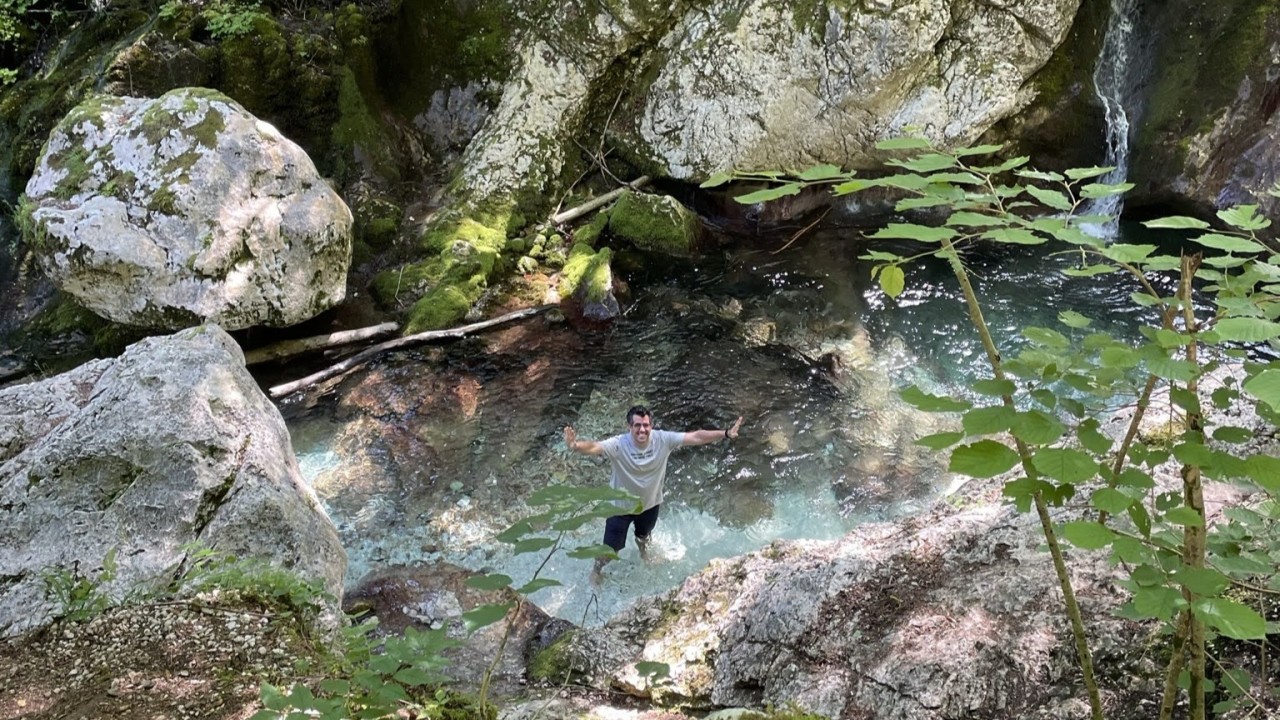
My kids have a name for trips to places none of their friends have heard of: “a Dad destination.” Slovenia was one of those. It also turned out to be one of the most rewarding trips we’ve ever taken as a family, ten days across Slovenia and Italy’s Veneto region that gave us more pristine nature and rich culture than we’d dared expect from such a short stretch of time.
Every hike we took, every river and forest we passed, seemed to confirm Slovenia’s reputation as Europe’s greenest destination.
Europe has made real strides in nature restoration over the last decades, but Slovenia stands out as one of its clearest success stories: a country that reversed centuries of deforestation, brought back species once driven to the edge of extinction, and, perhaps most distinctively, built its tourism industry around that same nature-positive transformation.
The broader European story is more sobering: centuries of development have left fewer than 3% of the continent’s forests old growth, the rest managed rather than wild. But Europeans are fighting to change that, as seen in Albania’s “Flamingo Revolution,” mass protests against a luxury resort planned across the protected Vjosa-Narta delta and island of Sazan. It’s a fight over which kind of tourism gets to exist around protected places, and Slovenia is one of the clearest answers Europe has found.
Slovenia’s story, shared throughout this essay, shows that a thriving nature-based tourism industry can only really take root once nature itself is protected and actively restored.
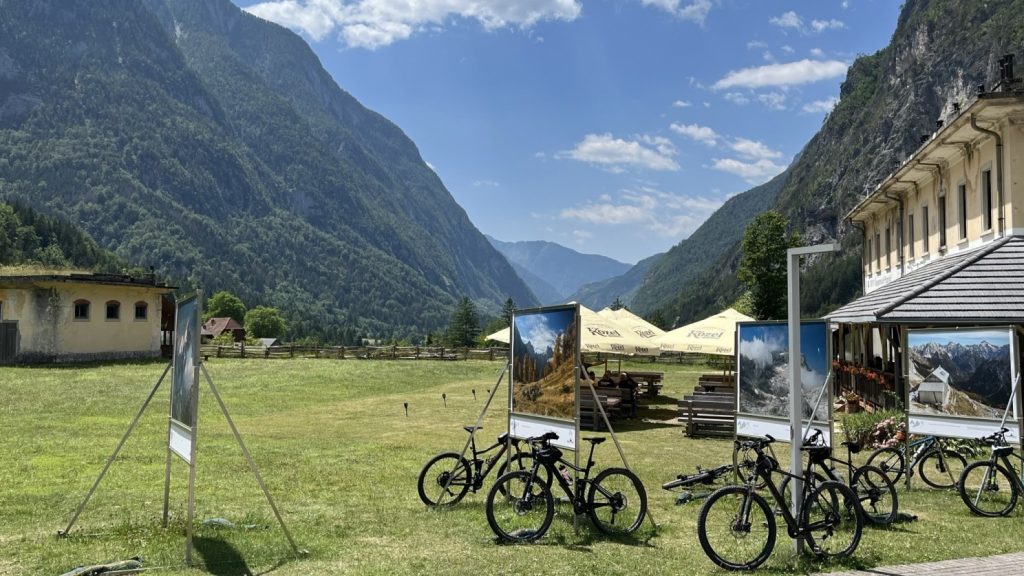
Our journey through Slovenia and Italy’s Veneto region
Our journey started in Ljubljana, Slovenia’s capital, a city that feels more like a relaxed small town than a capital. The Ljubljanica River curves through its old center, lined with cafés and bridges, with a castle watching over it all from a hill above. We stayed in a charming, family-run boutique hotel in a restored medieval building, perhaps 500 years old, right at the foot of Castle Hill, looking out at the Hercules Fountain.
Ljubljana is one of the recent winners of the European Green Capital award, earned through a real transformation: closing its main traffic artery to cars, overhauling its waste and recycling systems, and becoming a city built for pedestrians and cyclists rather than traffic.
We explored that pedestrian-first city on foot ourselves, on a wonderful walking tour. Our guide, Mateja, had the kids completely captivated with the legend of Urška and the river dragon and the story of the poet Prešeren as we crossed the Dragon Bridge. We also hiked up Castle Hill for views over the rooftops, and stumbled upon a chess competition in the public square below. The kids even had the chance to play a round themselves at one of the boards, a first for us.
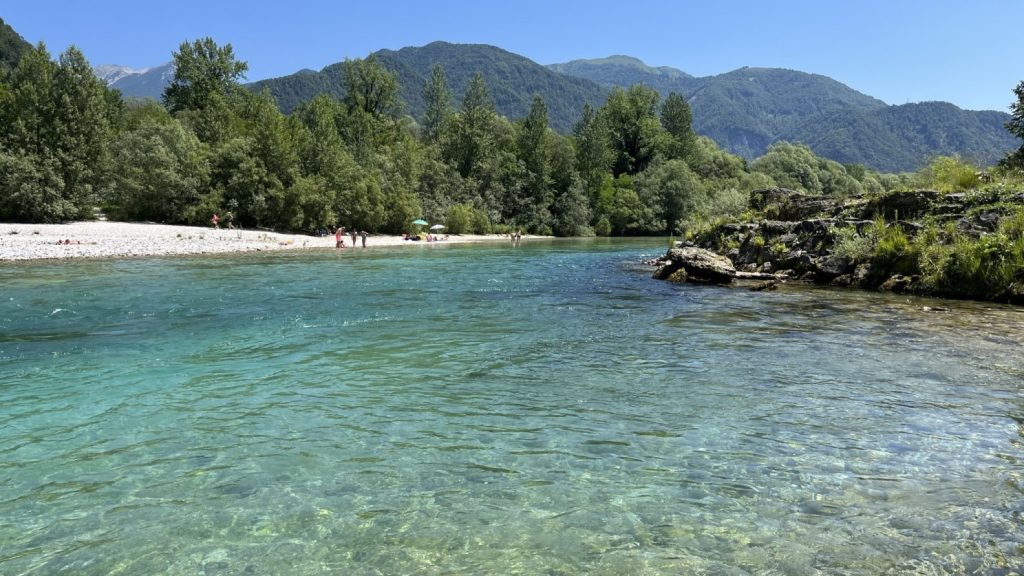
From Ljubljana we headed toward Triglav National Park, Slovenia’s iconic national park in the heart of the Julian Alps. We hiked for two days through beech and spruce forest, past rivers in colors that didn’t look real, deep turquoise and emerald cutting through impossibly green valleys. Most of our time was on the Soča Trail, which intersects with parts of the Walk of Peace, a UNESCO contender. The water was tempting, but far too cold to swim in, so we stepped in up to our knees and left it there.
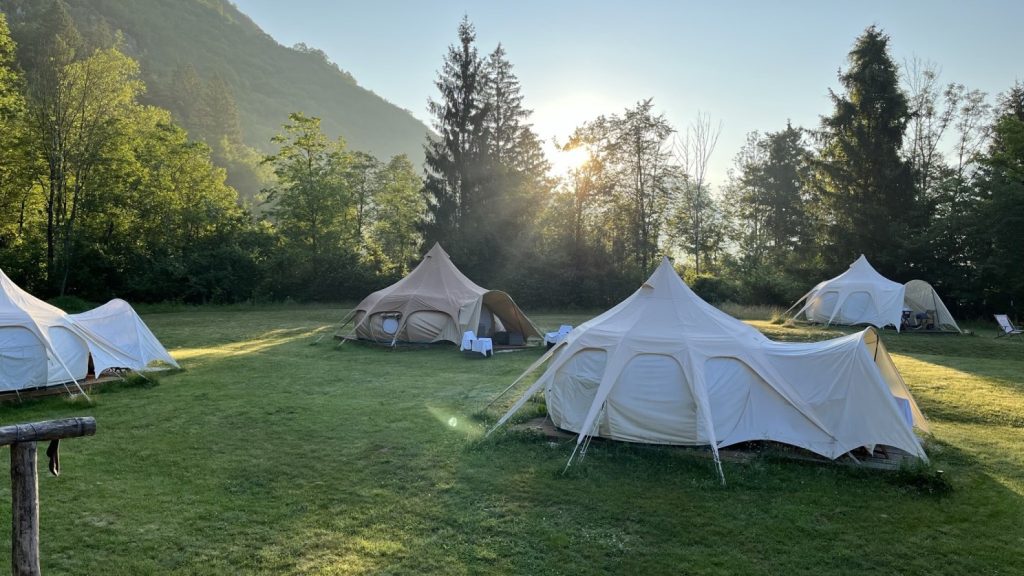
We stayed at a glamping site and working farm at the edge of the park near Bovec, met the young family running it, and woke each morning to fresh breakfast with homemade jam and honey from their own land, hiking to the nearby Boka and Virje waterfalls during our two nights there.
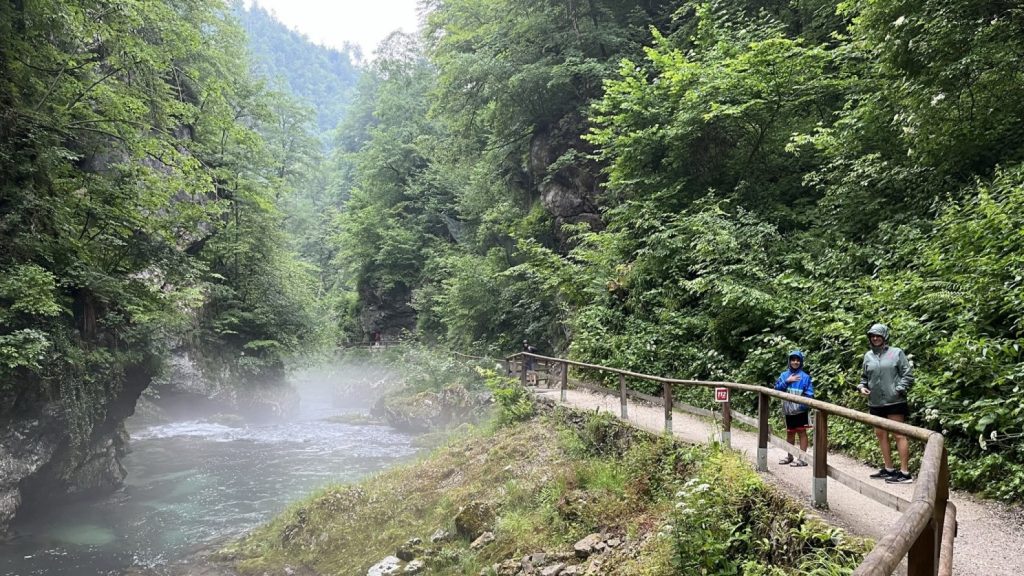
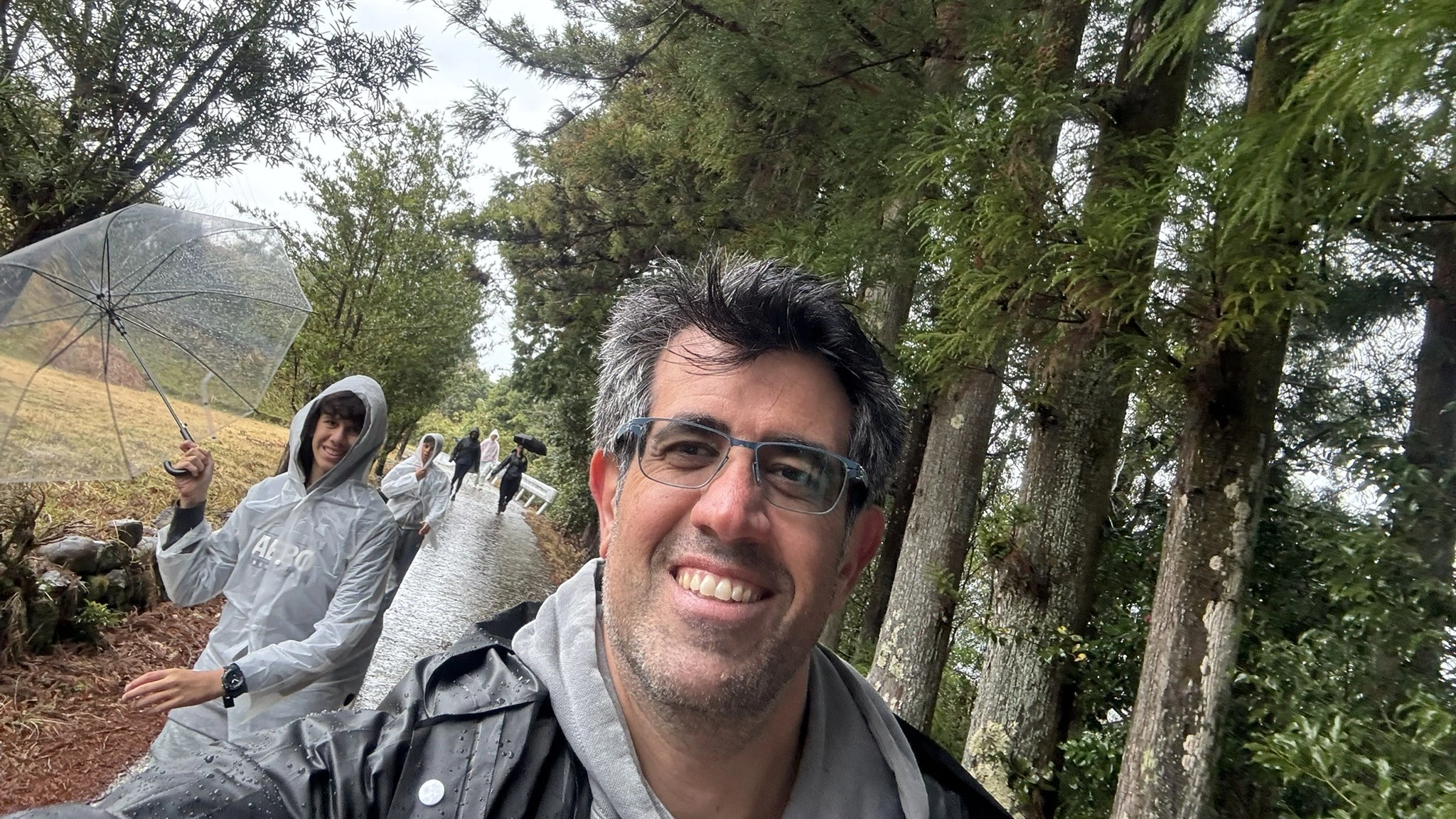
From Bovec, we drove on toward Kranjska Gora, stopping at a few scenic points before reaching Vintgar Gorge, the real highlight of the day. It was breathtaking even as the weather turned on us, hiking parts of it in rain and then snow, the wooden walkways clinging to the cliffside above the river. It was cold, and we were soaked to the bone by the end of it, the kind of day you only appreciate in hindsight, but it’s one of the parts of the trip I remember most vividly now.
Next was Bled, where we explored Bled Castle on its cliff above the lake, and the tiny island church reachable only by traditional wooden boats. We stayed nearby at a charming place by a stream, its cabins tucked among the trees, with a “green pool” kept clean through plants and natural filtration rather than chlorine.
Italy was so close we couldn’t resist a detour, heading to Venice for two nights and stopping in Treviso on the way back. In Venice, we took the kids on a gondola ride, and a boat out to Murano for its glassmaking tradition. But the stop that perhaps meant the most to us was St. Mark’s Basilica.
Inside the basilica, near the tomb of St. Mark, I asked a guide a few questions about the relics. He then asked where I was from, and when I said Alexandria, Egypt, his first reaction was, ‘we’re so sorry to have stolen your Saint.’ Outside, our own guide filled in the story behind that remark: in 828 AD, two Venetian merchants had smuggled Mark’s body out of Alexandria, where it had rested since his death there in the 1st century, making him Venice’s patron saint ever since, a story my kids couldn’t quite believe.
On the way back to Slovenia, we stopped in Treviso, a deliberate detour: it’s the town where my mother’s great-grandfather, a fur trader, came from before meeting her great-grandmother in Alexandria. What we didn’t expect was how genuinely charming the town itself would be, clean, chic, and sophisticated, with some of the warmest people we met on the whole trip.
Back in Slovenia, we ended the trip at Postojna Cave, a fitting last stop in a country with over 10,000 caves. It’s one of Slovenia’s longest cave systems at 24 kilometers, and the one that had the world’s first underground railway, built in 1872, something we had no idea existed until we were riding it ourselves, deep into the cave, before continuing on foot. It’s also home to the olm, a blind cave salamander that can live a century and go years without eating, of which we caught a brief, dim glimpse in the Vivarium at the entrance.
Let’s now explore how Slovenia got here, and how it became a European leader in sustainable nature-based travel.
Slovenia’s conservation and rewilding story
Slovenia is the third most forested country in the EU, after Finland and Sweden, with trees covering nearly 60% of its territory, and one of the most biodiverse countries in Europe for its size. It also holds the second-highest share of protected land in Europe, trailing only Luxembourg, with over 40% of the country under some form of protection, already clearing the EU’s 2030 target of 30%. That protection is layered, from Triglav National Park, to a wider network of regional and landscape parks, reserves, and natural monuments, to 355 Natura 2000 sites spread across farmland, forest, and coast, the largest share held by any EU country.
But conservation in Slovenia is a lot more than lines on a map; it shows up in how committed it has become to protecting its forests and biodiversity, managing its waste, and cultivating a culture of care.
During our trip, we saw the clearest sign of that commitment in something quite simple: the absence of litter. Across a full week traveling through the country, I cannot recall seeing a single piece of discarded waste, not on a trail, a riverbank, or a lake. Slovenia recycles or composts nearly 65% of its municipal waste, well above the EU average of roughly 50%, part of the same sustainability drive that helped make Ljubljana one of the recent winners of the European Green Capital award. Cleanliness, here, is simply the default.
That same care was easy to feel firsthand, hiking trails through dense alpine forest on the way toward the high limestone karst plateaus, air fresh enough to clear your lungs with every breath. Birdsong followed us most of the way: the alpine chough, a bird in the crow family, calling overhead, and the white-throated dipper flying along the river. We never made it deep enough into the high valleys to see chamois or ibex on the rockier slopes, or glimpse a golden eagle or a lynx, but knowing they were out there added its own quiet charge to the walk.
Slovenia has also become a rewilding leader in Europe. The Eurasian lynx, hunted to extinction, was reintroduced in the 1970s and, with support from the LIFE Lynx project, has grown to around 50 today. Bears and wolves recovered too, Slovenia’s bear population is up more than 40% in a decade, to near 1,000, with conflict-reduction measures like better fencing and guard dogs cutting livestock losses rather than the animals themselves.
While hiking, we learned something quite intriguing about another creature found in Slovenia’s forests: the Etruscan shrew, the smallest mammal in the world by mass, weighing about as much as a one-euro coin. The kids kept an eye out for one the rest of the way, though we never did spot it.
Inside the park, nineteen quiet zones protect sensitive birds and the park’s fragile bogs from foot traffic. The rivers get the same level of care: the Soča’s native marble trout, nearly bred out of existence by non-native stocking, has been slowly recovering since a 1996 ban. That patient work is probably why the trout we ate in the Soča Valley, grilled simply with herbs and lemon, was one of the standout meals of the trip, matched only by the trout we had again days later, just across the border in Italy.
The trout don’t recognize that border, and increasingly, neither does the conservation work protecting them. In July 2024, UNESCO merged Triglav with Italy’s neighboring Prealpi Giulie Nature Park into the Julian Alps Transboundary Biosphere Reserve, one of only a handful of cross-border biosphere reserves on Earth.
All of this work, quiet, patient, and mostly invisible to a visitor, is what made the kind of trip we took possible in the first place.
Built on nature: Slovenia’s tourism model
We were never alone out there, but we were never bothered either. From our glamping site to the hiking trails, every traveler we crossed paths with seemed to share the same respect for the place, the same quiet care about not disturbing it. It’s a feeling I rarely get while traveling: the people protecting the land, the businesses hosting you, and the travelers themselves all genuinely aligned, all pulling in the same direction.
That alignment is the result of years of coordinated work between government, academia, conservation groups, and the tourism industry, tracing back to 2016, when Slovenia received the world’s first Green Destination certification. That led directly to the Green Scheme of Slovenian Tourism, run by the Slovenian Tourist Board, whose own framing is explicit: unspoiled nature is Slovenia’s most important tourism asset, making conservation the foundation for the whole sector, not an afterthought.
Today the Slovenia Green Destination program covers over 60 towns and regions across the country. The Soča Valley, the area around Bovec where we spent two nights at a beautiful glamping site, is one of them.
Our glamping site, Gozdna Jasa, is run by Monika and David, who live on site with their young daughter, Kim, and run a small farm of their own. They built the place themselves, surrounded by mountains and within walking distance of two waterfalls. The tents are canvas, furnished with wood David built on site. Solar power runs the common areas, and the water comes straight from a nearby stream, carefully managed.
We ate homemade honey, jam, and cottage cheese with fresh berries and fruit, most of it from their own farm. Before we left, Monika and David gave us a jar of their honey to take home with us to Dubai.
Beyond the meals, we spent our time walking and hiking around the area. We didn’t have time for the more adventurous options, Monika and David also run rafting, kayaking, and ziplining trips nearby, but that’s on the list for next time.
Our two nights at Gozdna Jasa are a good example of the high-value, low-volume tourism promoted across Slovenia. At a broader level, Slovenia also actively controls overtourism, assessing the carrying capacity of its most popular natural sites and working to cut noise and air pollution by encouraging low-emission transport over cars. The quality of the experience we had wasn’t an accident, it came from a deliberate and coordinated management system.
What the rest of the world could learn
This trip gave us a glimpse of something genuinely rare in Europe: nature that still feels wild, rather than just managed and labeled as green. Given how urbanized and industrialized most of the continent has become, that’s no small thing, and it’s only possible because of the restoration and rewilding work happening behind the scenes.
That sequence, protection first, restoration second, tourism third, is the throughline of everything in this essay, and it’s what lets nature and tourism grow together rather than at each other’s expense.
It’s also why others are starting to pay attention. What we experienced in the Soča Valley is replicated across the country, consistently enough that the European Travel Commission has used Slovenia’s framework as the basis for its own EU-wide sustainability guidance. Slovenia has also been positioned as a likely model destination ahead of the UN’s designation of 2027 as the International Year of Sustainable and Resilient Tourism.
Can other countries replicate Slovenia’s model? The first place I’d look is a country’s underlying commitment to protecting its natural environment and heritage, and how broadly that commitment is shared across government, business, and ordinary people. That’s the real bottom line for any successful model of green tourism, everything else, the certifications, the labels, the marketing, is built on top of it.

Leave a Reply